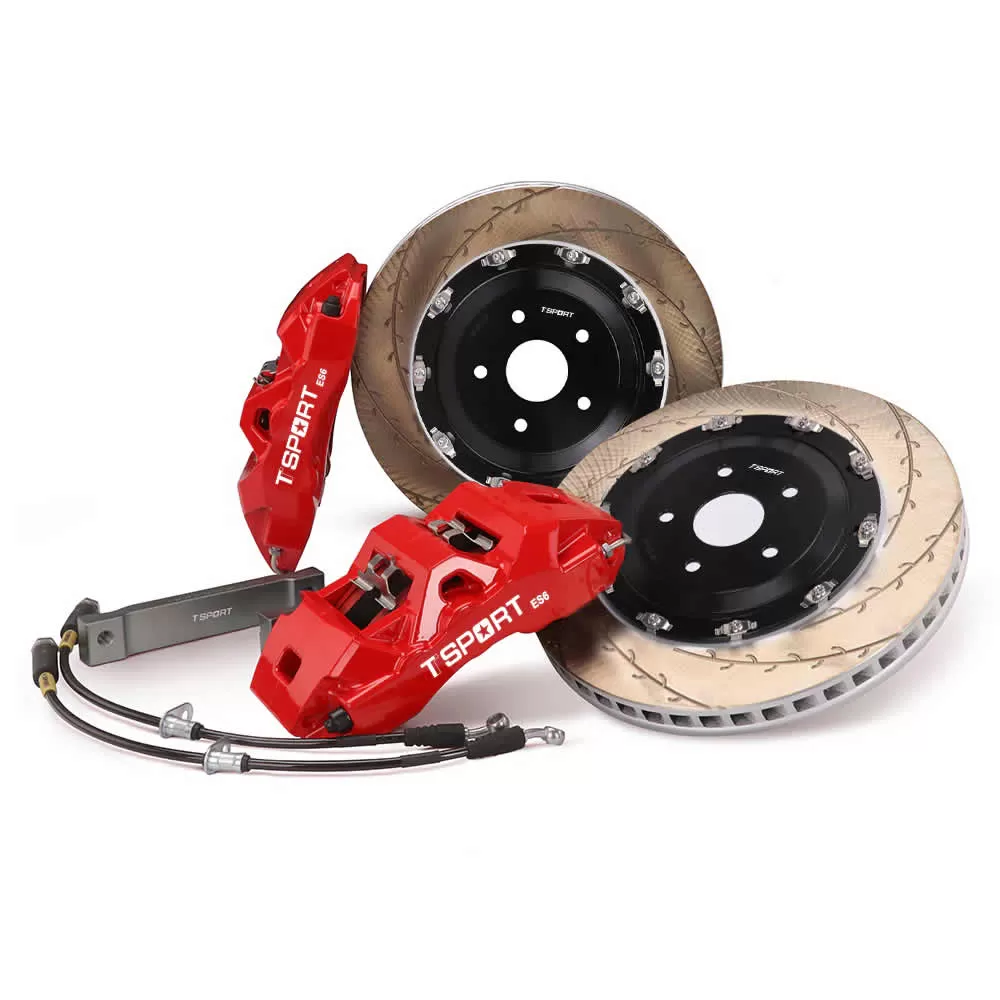
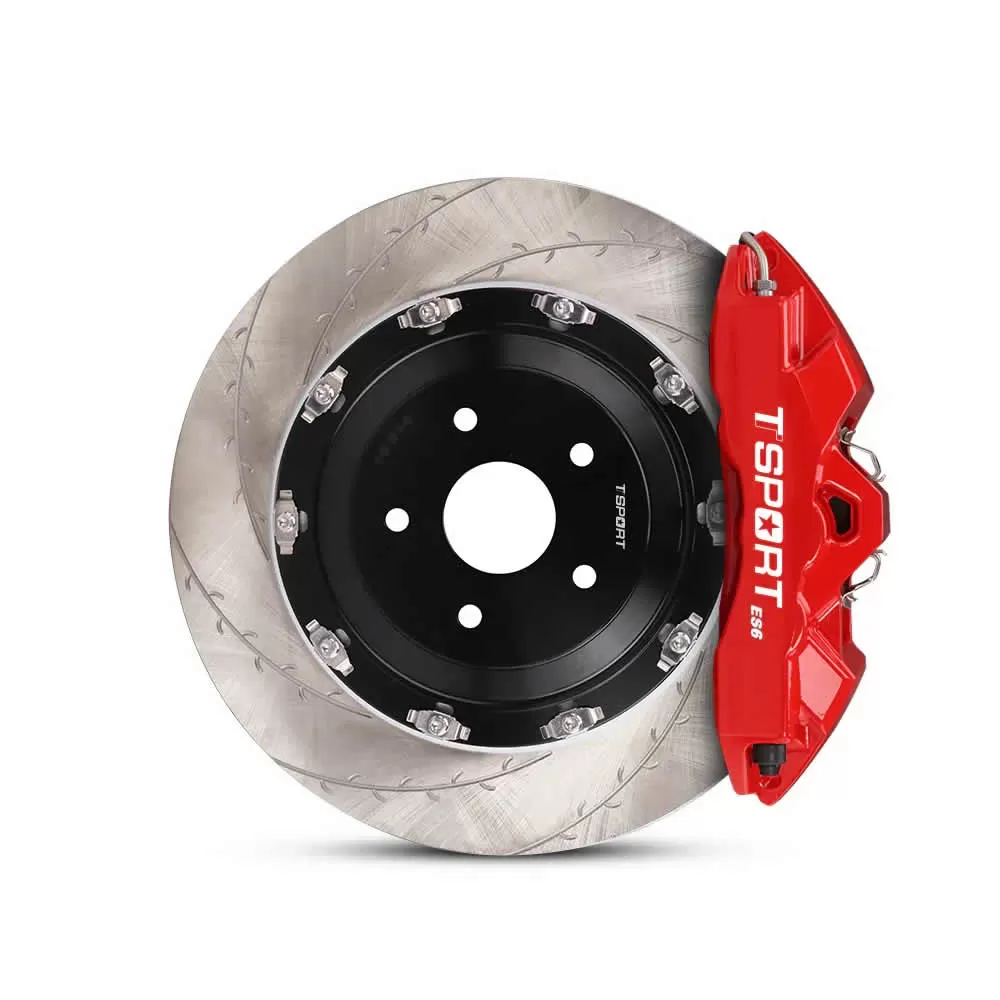
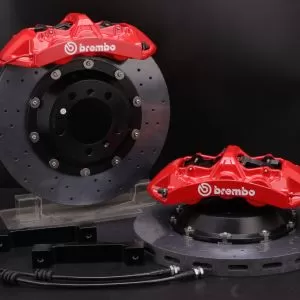
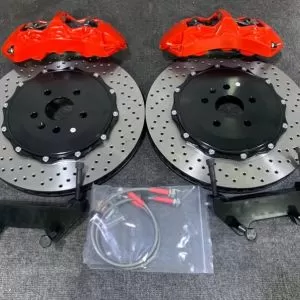
The TTSPORT Evolution ES6 is a front big brake upgrade kit featuring a two-piece forged 6-piston caliper, a 32mm two-piece brake disc, and matched friction materials. The ES6 is designed to deliver a firmer pedal feel, stronger initial bite, and stable, reliable braking performance for both street and track use.
As a lightweight, street-oriented 6-piston front brake kit within the "Evolution" series, the ES6 offers compatibility with 18-inch wheels, a linear and refined pedal feel, and excellent daily durability. It represents a cost-effective solution that balances safety upgrades for family vehicles with the demands of light performance driving.
1. Caliper Technical Specifications
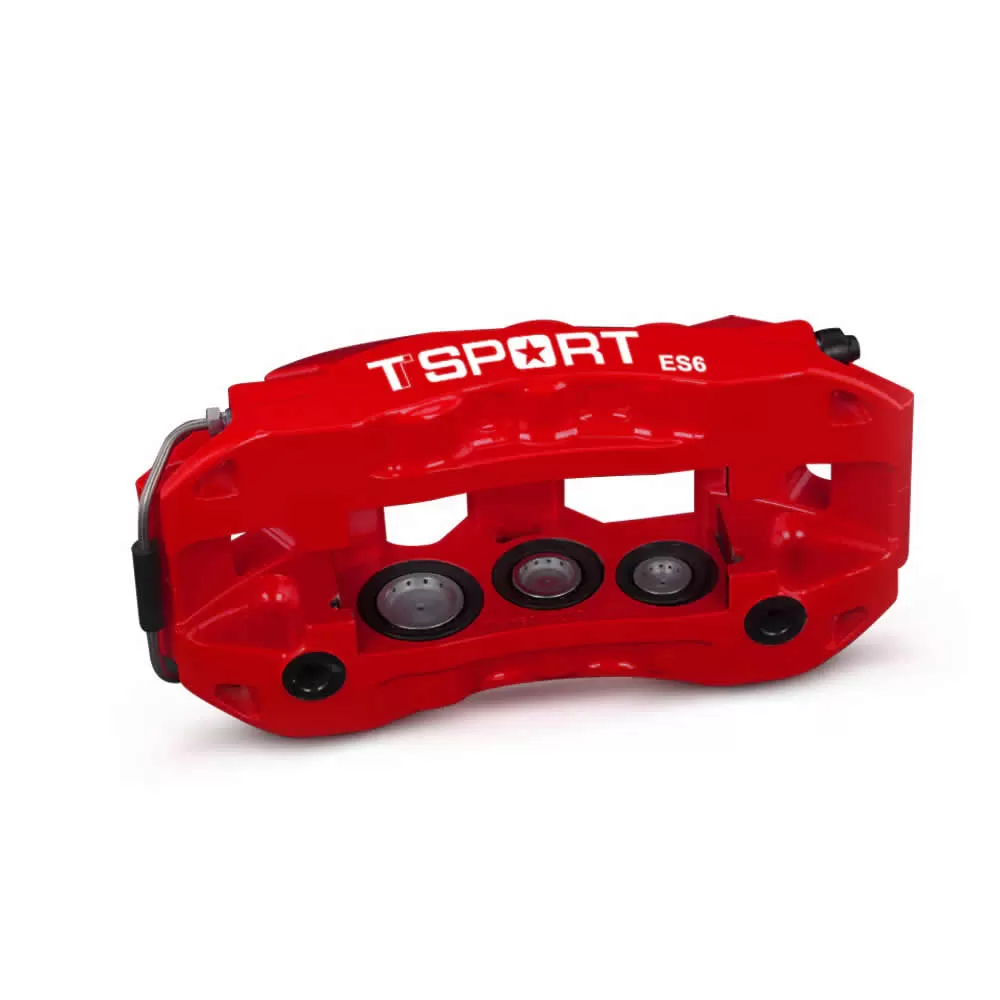
The ES6 utilizes a two-piece forged aluminum alloy opposed 6-piston caliper. Its asymmetrical body design balances lightweight construction with structural rigidity; the forging process optimizes alloy grain density, resulting in a superior stiffness-to-weight ratio compared to cast calipers. This minimizes deformation under high-pressure braking and provides more direct pedal feedback.
Piston Layout: Features a staggered piston diameter design. On each side, the three pistons measure 27mm, 32mm, and 38mm in diameter, totaling six opposed pistons; the total piston area per caliper is 50.2 cm². This staggered configuration balances pressure distribution across the entire brake pad surface, mitigates uneven (tapered) wear over time, and ensures linear, controllable braking force output.
Piston Structure: Employs a two-piece heat-insulating piston design, equipped as standard with dust boots and high-temperature oil seals. This construction reduces heat transfer to the brake fluid, preventing pedal feel degradation during continuous braking, while also protecting against dust and road salt corrosion during daily driving to extend maintenance intervals. Physical Specifications: Caliper dimensions are 294mm (L) × 155mm (W) × 84mm (H); net weight per caliper is 3.95kg (excluding brake pads). Features a high-temperature, glossy finish with excellent corrosion resistance.
Mounting Structure: Radial mount design paired with vehicle-specific, CNC-machined carbon steel brackets, engineered to fit the specific steering knuckle specifications of various vehicle models.
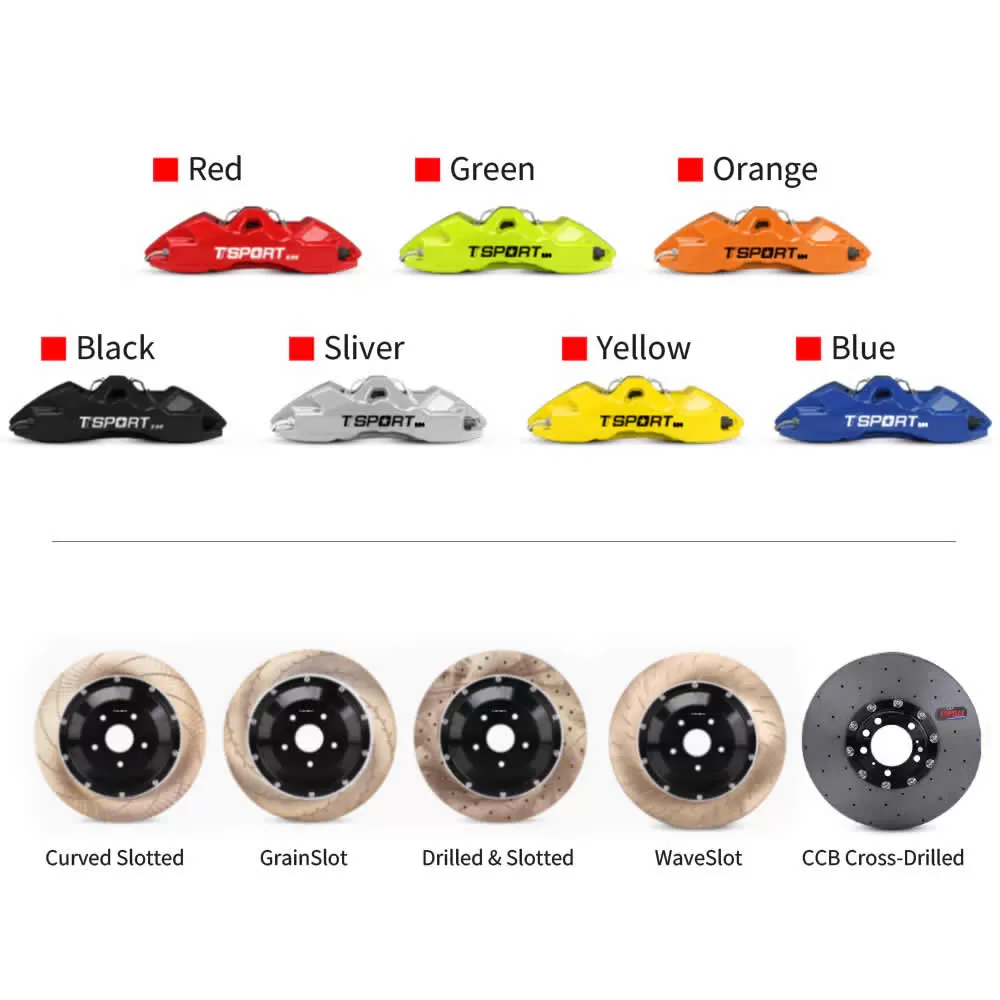
Color Options: Available in seven standard caliper colors—red, fluorescent green, orange, black, silver, yellow, and blue—with support for custom color options.
2. Brake Disc and Pad Configuration
Brake Disc Specifications
All models come standard with 32mm-thick, two-piece internally ventilated brake discs. Two diameter options are available, with material choices including heat-treated high-carbon cast iron and carbon-ceramic (CCB).
|
Series
|
Evolution
Series
|
|
Model /
Application
|
ES6
|
|
Axle
Position
|
Front
|
|
Piston
Count
|
6-piston
|
|
Piston
Type
|
Two-piece
heat-insulated pistons with dust boots
|
|
Piston
Diameter
|
27 mm ×
2 / 32 mm × 2 / 38 mm × 2
|
|
Caliper
Dimensions
|
L 294 mm
× W 155 mm × H 84 mm
|
|
Total
Piston Area
|
50.2 cm²
per caliper, all pistons combined
|
|
Manufacturing
Process
|
Two-piece
forged aluminum body
|
|
Net
Weight
|
3.95 kg
per caliper, without pads
|
|
Surface
Finish
|
High-temperature
gloss coating
|
|
Recommended
Wheel Size
|
18 in or
larger
|
|
Recommended
Rotor Size
|
Ø355–380
mm × 32 mm
|
|
Brake Rotor Options
|
|
Rotor
Option
|
Iron
(Standard)
|
Carbon-Ceramic
(Option B)
|
|
Rotor
Material
|
Heat-treated
high-carbon cast iron
|
Carbon-ceramic
composite
|
|
Axle
Position
|
Front
|
Front
|
|
Rotor
Dimensions
|
Ø355 /
380 mm × 32 mm
|
Ø355 /
380 mm × 32 mm
|
|
Construction
|
Two-piece
rotor assembly
|
Two-piece
rotor assembly
|
|
Ventilation
|
Internally
vented
|
Internally
vented
|
|
Rotor
Mounting
|
Fixed or
floating, depending on rotor size & vehicle application
|
Floating
|
|
Directional
Design
|
Yes —
left/right specific
|
Yes —
left/right specific
|
|
Rotor
Face Pattern
|
Curved
slot / Grain Slot / Wave Slot / Drilled and slotted
|
Cross-drilled
|
|
Brake Pad Options
|
|
Pad
Option
|
For Iron
Rotors
|
For CCB
Rotors
|
|
Compatible
Rotor Material
|
Iron /
steel rotors only
|
Carbon-ceramic
rotors only
|
|
Operating
Temperature Range
|
0–600 °C
|
0–700 °C
|
|
Average
Friction Coefficient
|
μ ≈ 0.38
(varies with temp, pressure, rotor condition)
|
μ ≈ 0.45
(varies with temp, pressure, rotor condition)
|
|
Lines
|
|
Brake
Line Construction
|
Three-layer
construction
|
|
Brake
Line Material
|
PTFE
inner liner / SUS304 stainless braid / PVC outer sheath
|
|
Brake
Line Fittings
|
Vehicle-specific;
caliper-side and chassis-side fittings vary by application
|
|
Brackets
|
|
Rotor
Hat Manufacturing Process
|
CNC-machined
|
|
Rotor
Hat Material
|
High-strength
aluminum alloy
|
|
Caliper
Bracket Manufacturing Process
|
CNC-machined
|
|
Caliper
Bracket Material
|
Carbon
steel
|
|
Caliper
Mounting Type
|
Radial
mount with vehicle-specific brackets
|
|
Fitment & Installation
|
|
Minimum
Spoke Clearance
|
99 mm
|
|
Recommended
Wheel Size
|
18 in or
larger
|
|
Bedding-In
|
Required
after installation
|
The discs feature CNC-machined, high-strength aluminum alloy hats designed to absorb thermal expansion and contraction, thereby minimizing disc deformation and reducing the risk of brake shudder.
Brake Pad Parameters
Specific brake pad compounds are matched to the corresponding disc types; official specifications are as follows:
Brake pads for steel discs: Operating temperature range of 0–600°C; average friction coefficient (μ) ≈ 0.38. Offers stable braking performance and minimizes excessive disc wear; suitable for daily driving and light spirited driving.
Brake pads for carbon-ceramic discs: Operating temperature range of 0–700°C; average friction coefficient (μ) ≈ 0.45. Formulated specifically for carbon-ceramic discs, delivering superior braking force and fade resistance at high temperatures.
Official Requirement: Brake pad and disc materials must be correctly matched; mixing materials is strictly prohibited.
3. Ancillary Components and Complete Kit
Core Ancillary Components
Braided stainless steel brake lines: Three-layer construction featuring an inner PTFE layer, a middle SUS304 stainless steel braided layer, and an outer PVC protective sheath. This design virtually eliminates hose expansion under high pressure, resulting in a firmer pedal feel and more direct braking force transmission. Fittings are vehicle-specific, designed to connect seamlessly to both the caliper and chassis interfaces. Installation Hardware: The caliper mounting brackets are CNC-machined from high-carbon steel, and the brake disc hats are made of high-strength aluminum alloy; both are custom-made based on specific vehicle model data. A complete set of installation fasteners is included as standard.
Standard Kit Contents
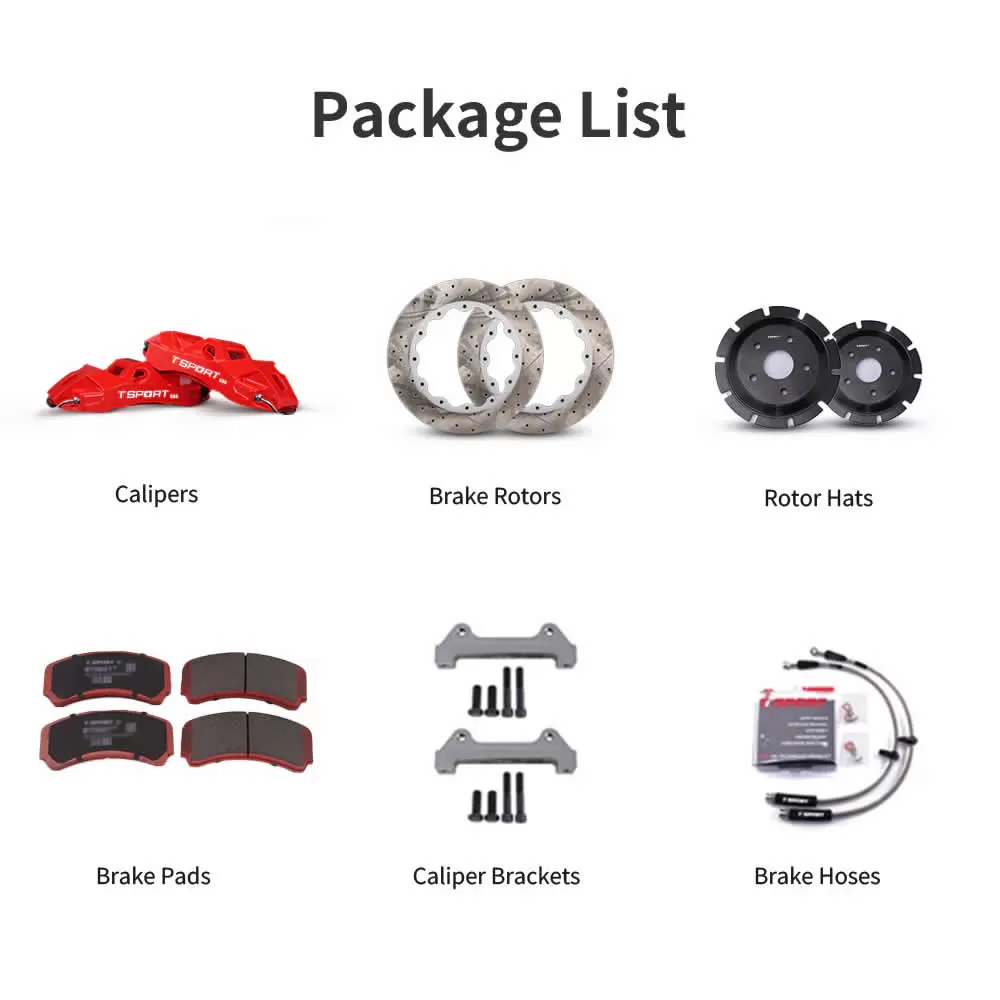
The complete vehicle-specific front-wheel kit includes:
2 x ES6 forged 6-piston front calipers (left and right specific)
2 x Two-piece brake discs (in the selected specification)
1 x Set of matching brake pads
2 x Sets of vehicle-specific radial-mount caliper brackets
2 x Aluminum alloy brake disc hats
2 x Stainless steel braided brake lines
Complete set of installation fasteners and brake pad bedding-in instructions
4. Fitment Requirements and Real-World Examples
Mandatory Installation Prerequisites
Wheel Size Requirement: Minimum 18-inch wheels required; 355mm discs are designed for 18-inch wheels, while 380mm discs require additional verification of internal wheel clearance.
Internal Wheel Clearance: A minimum clearance of 99mm is required between the inner wheel spokes and the caliper; wheel offset (ET value), spoke design, and barrel depth affect actual compatibility. We officially recommend verifying fitment using a dedicated clearance template before ordering.
Fitment Method: This is a platform-based custom kit that adapts to different vehicle models using specific brackets, hats, and brake line fittings. Complete vehicle details—including model year, trim level, and wheel specifications—must be provided when ordering to confirm compatibility.
Mandatory Bedding-In: A proper brake pad bedding-in procedure must be performed before aggressive driving to establish a uniform transfer layer of friction material on the disc surface; skipping this step can lead to issues such as brake judder, uneven braking force, and abnormal disc wear.
Vehicle models with proven modification setups include:
MPVs: Toyota Alphard / Vellfire (AH30/AH40) – compatible with stock 18-inch wheels without spacers;
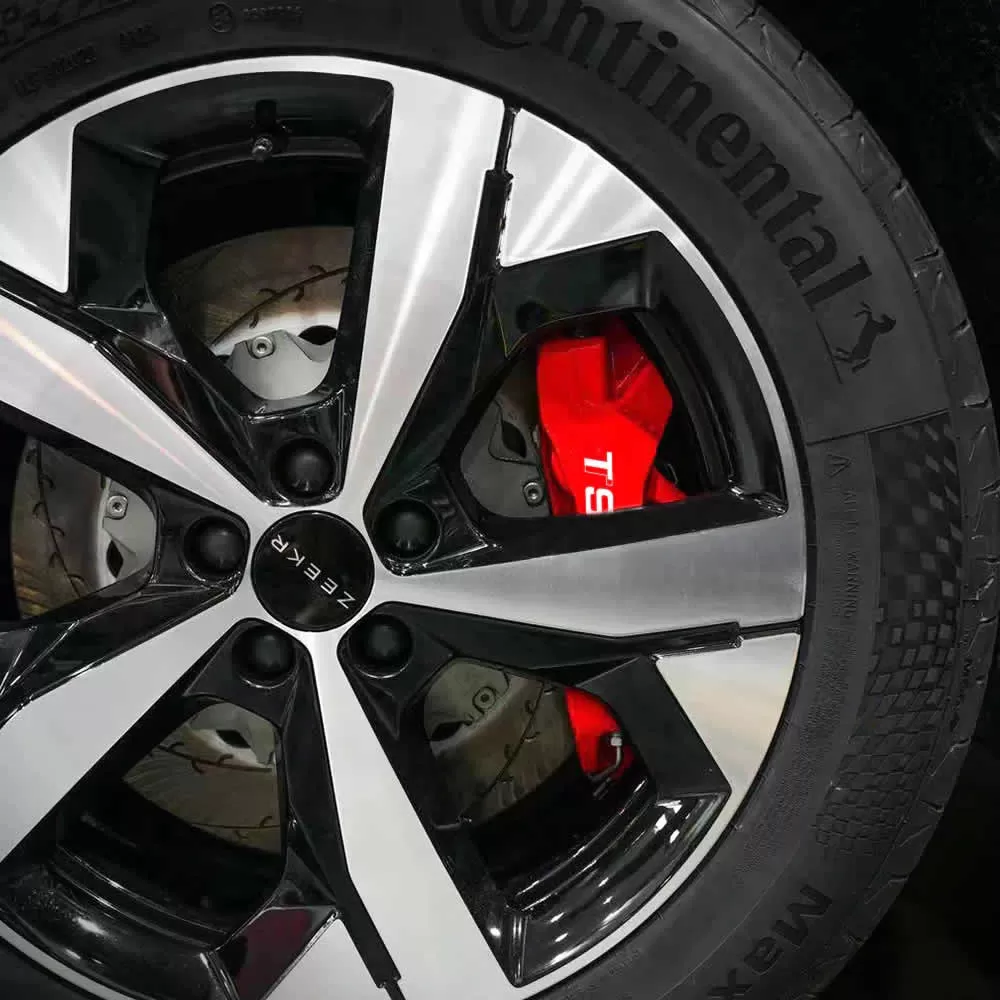
New Energy Vehicles (NEVs): ZEEKR 001, ZEEKR 009 – compatible with 19-inch wheels when paired with 380mm brake discs;
Mid-size sedans: Honda Accord, BMW 3 Series (G20/G28/G21) – compatible with select stock 18-inch wheels;
Other mid-size SUVs, sedans, and MPVs in the same class – fitment can be achieved via custom mounting brackets provided there is sufficient installation space.
The ES6 is one of TTSPORT’s most popular 6-piston calipers for street use, positioned as a "lightweight street performance upgrade." Compared to the EB6 model in the same series, it is more compact and has lower fitment requirements, fitting stock 18-inch wheels. It is particularly suitable for owners of heavier family MPVs, mid-size sedans, and SUVs seeking a safety-oriented braking upgrade, while also capable of handling light, spirited driving during entry-level track days.
5. ES6 FAQs
What wheel size is required to install ES6 calipers?
The ES6 caliper requires a minimum wheel size of 18 inches and a clearance of at least 99 mm between the inner wheel spokes and the caliper. Wheel offset, spoke design, and brake disc diameter all affect fitment; therefore, before ordering, please verify that there is sufficient clearance based on the caliper's dimensions (Length 294 × Width 155 × Height 84 mm).
The ES6 is a large-format brake kit tailored to specific vehicle platforms. The caliper brackets and brake line fittings are customized for your specific vehicle; please confirm your vehicle's year, make, model, trim level, and wheel specifications with our team before purchasing.
Should I choose 355mm or 380mm brake discs?
If your driving consists primarily of daily commuting or spirited street driving—and you are constrained by wheel clearance or have specific requirements regarding unsprung mass—the 355mm brake disc is recommended. However, if you engage in track driving, operate a heavy vehicle, or frequently perform high-speed braking maneuvers, and require maximum thermal capacity, the 380mm disc is the better choice.
What is the difference between steel brake discs and carbon-ceramic (CCB) options?
High-carbon cast iron discs paired with brake pads featuring an operating temperature range of 0–600°C and an average friction coefficient (μ) of 0.38 offer excellent cost-effectiveness for both street and track use. In contrast, the carbon-ceramic (CCB) option utilizes specialized pads (operating range 0–700°C; average friction coefficient 0.45); these systems offer reduced unsprung mass and superior resistance to thermal fade, making them ideal for high-intensity track driving.
Is a bed-in procedure required?
Yes. Proper bedding-in is essential to ensure the uniform transfer of brake pad material onto the disc surface, stabilize the friction layer, and fully realize the pads' braking power and linear pedal feel. Skipping this step can result in uneven friction material deposits, vibrations, and compromised brake pedal feedback.